
Associate lifecycle
- Mapping the end-to-end employee experience
The Associate Life Cycle Journey was created to understand and visualize the major phases of an associate’s experience while employed at CHRISTUS Health. This framework became the foundation for multiple enterprise UX initiatives, including the Associate Portal redesign, Onboarding Portal, and Manager Hub.
My Role: UX Research and Design
Skills Used: Research, Information Architecture, Journey Design
The Problem
The organization lacked a unified, end‑to‑end understanding of the associate experience, resulting in fragmented processes, inconsistent communication, and unclear pathways for both associates and managers. Critical moments—such as onboarding, life events, career development, and offboarding—were spread across disconnected systems, making it difficult to identify pain points or design cohesive solutions. Without a holistic view of the employment journey, teams struggled to support associates effectively or prioritize improvements across the lifecycle.
The Journey Structure
The Associate Life Cycle Journey is organized into three major phases that reflect the full arc of an associate’s experience within the organization. Each phase captures the key moments, needs, and system interactions that shape how associates navigate their employment, enabling a holistic understanding of where support, clarity, and digital improvements are most needed.
Phase 1: Recruiting, Onboarding & Training
This phase covers the earliest touchpoints—from initial awareness and application through hiring, orientation, and early training. Associates often enter the organization with limited context, making clarity, guidance, and timely communication essential. This phase highlights the importance of streamlined processes, transparent expectations, and role‑specific onboarding pathways that help new hires feel confident and supported as they transition into their roles.
Phase 2: Life Events & Talent Development / Mobility
The second phase represents the most complex and dynamic portion of the journey. It includes major life events such as benefits enrollment, leave of absence, compensation changes, and personal transitions, as well as professional growth moments like performance development, internal mobility, and career advancement. Because these experiences span multiple systems, policies, and stakeholders, associates often face friction and uncertainty. Mapping this phase revealed critical opportunities to simplify workflows, unify information, and provide proactive, role‑aware guidance that supports associates throughout their evolving needs.
Phase 3: Retirement or Resignation
The final phase focuses on the transition out of the organization, whether through retirement or voluntary resignation. Associates require clear instructions, accessible resources, and a respectful, well‑structured offboarding process. This phase emphasizes the importance of preserving knowledge, ensuring compliance, and maintaining a positive final experience that reflects organizational values.
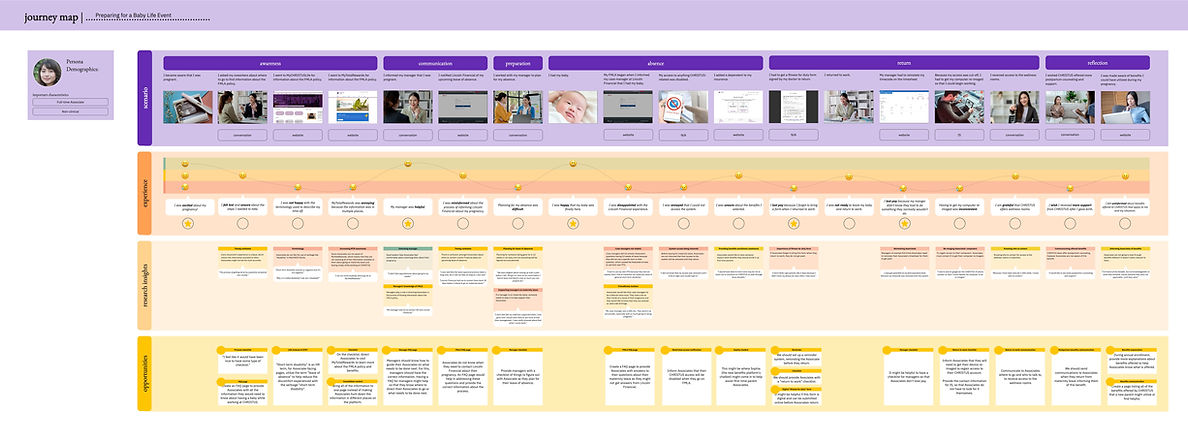
Below is one of many Journey Maps that shows detailed view of the moments-that-matter in each phases of Associates's Journey.
Impact & Outcomes
The Associate Life Cycle Journey became a foundational framework that aligned stakeholders around a shared understanding of the end‑to‑end associate experience. By visualizing the three major phases and their interconnected touchpoints, the journey exposed critical gaps, redundancies, and pain points across systems and processes. This clarity directly informed the redesign of the Associate Portal, Onboarding Portal, and Manager Hub, enabling more intuitive navigation, role‑based personalization, and streamlined workflows. The framework also supported leadership decision‑making by highlighting where digital investments would have the greatest impact. Ultimately, the journey map established a scalable model that continues to guide future experience improvements across the organization.
Let’s
Connect
